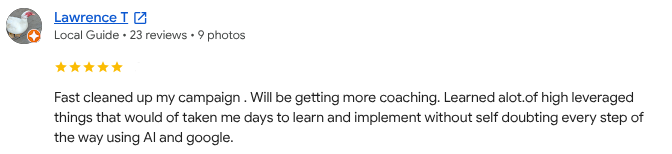
When is amazing Google Ads performance actually a sign that you need to change your strategy?
I recently had my second Google Ads coaching call with Amy. You might remember Amy's story from a previous The Insider newsletter issue called "She thought she was breaking even. Google lied."
Quick recap: On our first call, I discovered that Amy was double counting conversions in Google Ads, so her ROAS of 2 (which she wanted to improve) was really only a ROAS of 1. Yikes! This was exacerbated by the fact that she was using manual CPC bidding, so her Shopping campaign was prioritizing the cheapest clicks, rather than the most profitable clicks.
Now, 6 months later, after implementing the recommendations from our first call, Amy's Shopping campaigns are both achieving a real ROAS greater than 5! Her website is bringing in more revenue than her Etsy shop for the the first time in 15 years, and she wants to scale up even further in anticipation of the holiday season.
So what are our next steps?
This issue of The Insider is sponsored by Optmyzr
Optmyzr's MCP just landed in Claude's official MCP Directory. It's gotten sharper lately, too — it can now create and apply new keywords for you right in the chat (with your sign-off before anything goes live), and LinkedIn Ads data just joined Google, Microsoft, and Meta in the mix.
(affiliate link)
Amy sells handmade products. To disguise her niche, let's say she has two product categories: bracelets and rings.
Her bracelets campaign was achieving a 5.24 ROAS on a Target of 500%, with search impression share sitting at 18%. That's great news; the Shopping campaign is meeting her goals, and has plenty of room to grow.
66% of lost impression share was due to budget, while 15% was lost due to rank. This is the best problem to have! By simply increasing the budget, Amy should be able to scale her bracelets campaign without sacrificing ROAS. In fact, she can probably increase her ROAS and her budget together, especially as the holiday season approaches.
Now, her rings campaign was achieving a similar ROAS of 5.8. However, its search impression share was much higher at 44%. More importantly, her lost impression share due to budget was 0%, while lost impression share due to rank was 55%.
This is completely different from her bracelets campaign. In order to scale rings, Amy will need to lower her ROAS target because all of her lost impression share is coming from rank, not budget. That means she's losing the auction, not that the campaign is running out of money.
Here's the action plan I put together for Amy to prepare for the holiday season:
- Bracelets: Raise Target ROAS and budget every other week by 10-15%. Keep an eye on Search lost IS (rank) vs Search lost IS (budget) to determine when to stop raising ROAS and when to stop raising budget. (This will probably happen at different times.) Aim for 30-40% total impression share going into the holiday season, assuming ROAS is still acceptable.
- Rings: Keep Target ROAS and budget as-is. If Search lost IS (budget) starts to increase as holiday search demand picks up, increase budget to match, but leave Target ROAS where it is to maintain profitability.
Remember, impression share is not a metric to optimize for, but it is an important diagnostic tool. When your campaigns are meeting their ROAS goals, impression share lets you know how much you can scale. As Amy saw with bracelets and rings, they may have the same ROAS, but different impression share metrics means different strategies for growth.
Need your own action plan for growth? Book a call with me, and we'll put together a custom Google Ads growth plan for your business.